Greetings all! Not sure if this is the right thread, but hopefully it’s OK to post here.
Loving the microtonal update, but have one issue keeping Renoise from being my DAW of choice for microtunes:
I wish there was a table/other method where we could easily “rename” all the notes, so that instead of showing “C-4”, C#-5", etc, we could give our own identifier for each note. Even if it were not customizable, having the ability to change these note names to midi note number (i.e. 0 to 127) or follow a clear pattern which doesn’t repeat every 12 notes (i.e. using letters A-Z which increment to the next “octave” ever N notes, where N is user definable) would be SUPER helpful when doing music based around a non-western tuning system.
For example, if I am composing music in a 5-note scale (like 5-EDO), it is very confusing to have C-4 and F-4 be an octave apart, and makes it extremely challenging to intuitively read patterns in the editor. This is even more confusing when the scale your using has more than 12 notes (i.e. Arabic tuning systems), or lacks an octave, or doesn’t repeat at all!
so, i got asked this recently and i came up with a non-note solution.
i’ve added it to paketti.
this is basically a method of reading a textfile that has the naming convention that is followed - and they are printed to the sample fx column.
it’s not quite the same as changing what the pattern says re “b-2” to bki4df or wotevs, but it at least lets you create a reference of your own, and use it.
From another perspective : I’m a musician and a teacher who is working on a new system to wright music and name the notes. I would also reeeaaally love to be able to choose my own custom 2 character for each 12 (or more) notes. Many country like france and germany for exemple, have different notes names. IMHO trackers could have a unique power in music education to get student and beginner into writing music, custom note name they already know would facilitate the learning curve. These kind of accessibility features are really under value IMO. Since this is hardcoded we cannot really do this properly ourselfs using lua if I understand correctly.
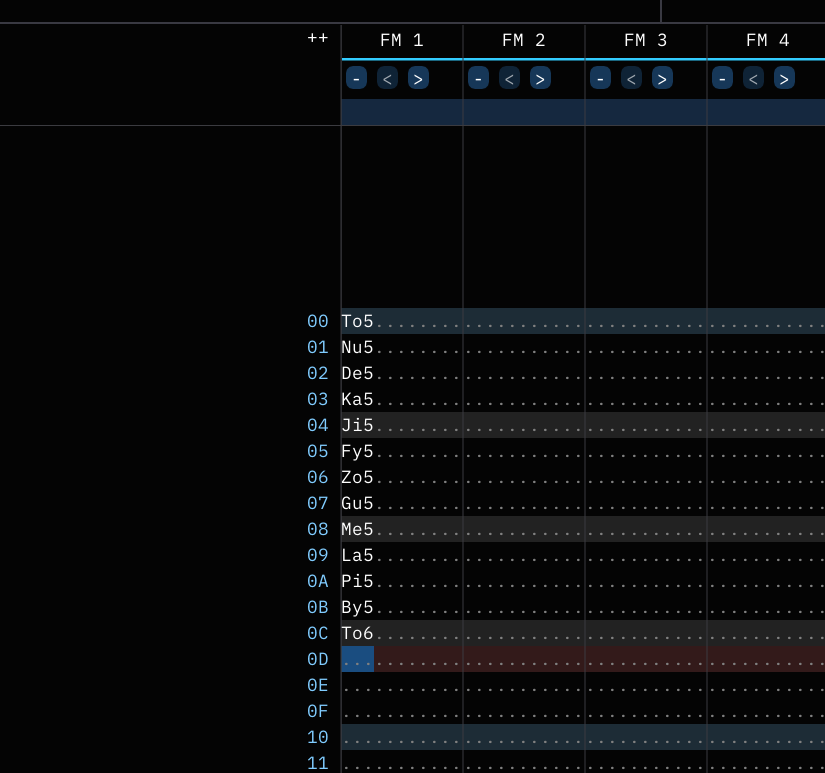
I did it in furnace tracker by messing with the code base, it’s hard coded but since furnace is open source I was able to do it for myself. Here’s a sceenshot with the full chromatique scale starting from C (To) :
This is surely a bit niche, but proper flat/sharp accidental is not, and I don’t think it would take a lot of work (but what do I know ^^). I could be worth it.