ENDOGEN ~ lowercase / microsound / drone synthesis ecosystem (Max + SuperCollider)
Deep Generative Drift | 25 Minutes of Endogen \ 404 Failure Sc Node
Hi everyone,
I wanted to share a project that might interest those working with microsound, lowercase, drone, and electroacoustic sound design.
ENDOGEN is an advanced synthesis + sampling environment designed to operate at very low levels by default (near-silence), with subtle dynamics and behaviors that emerge over time. It’s not a preset machine and not a “wow in 5 seconds” instrument — it’s more of a living sound ecosystem meant to be explored, listened to, and recorded.
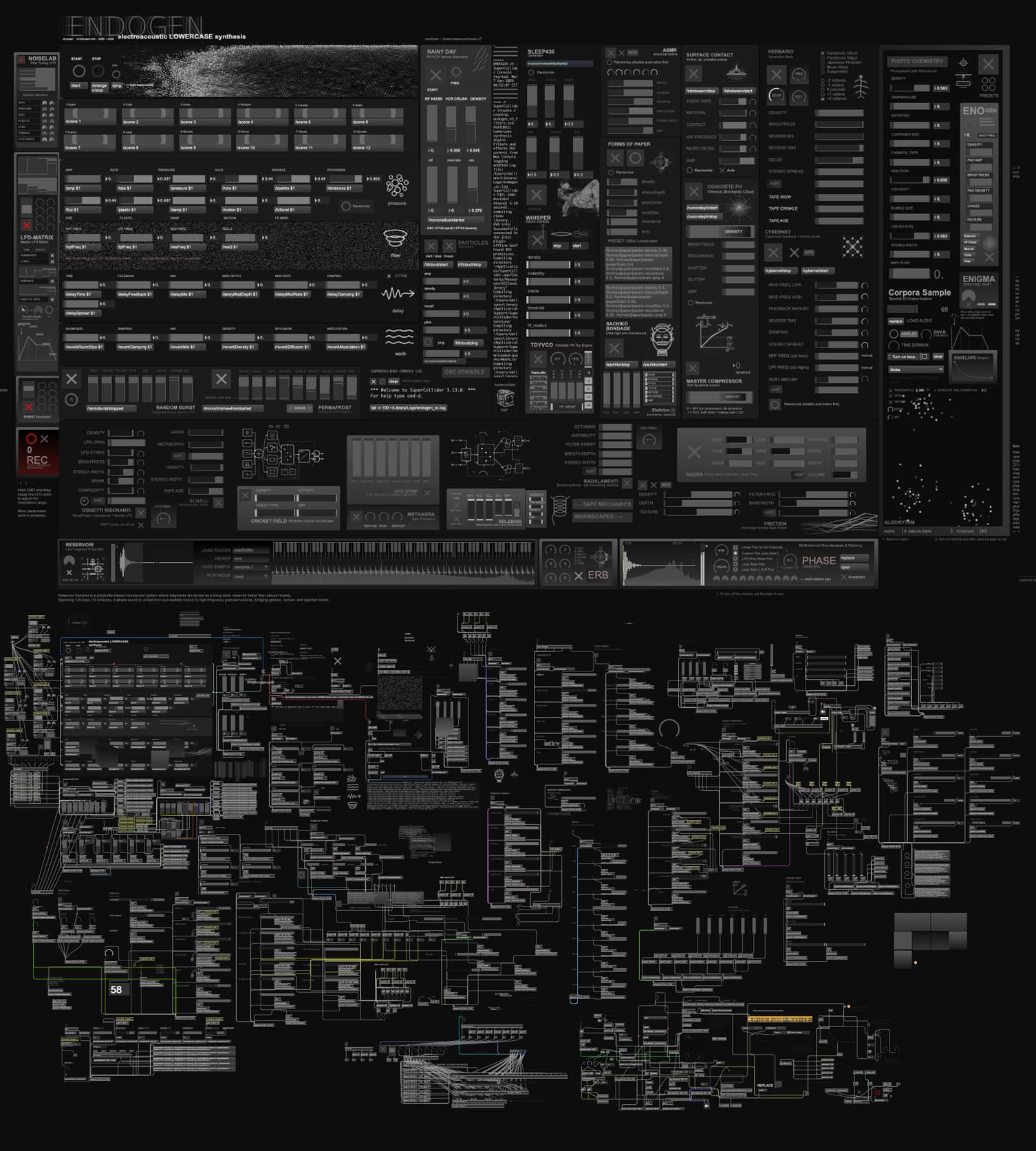
What it is
ENDOGEN is a modular system built around drift, feedback, microsound detail, and long-form evolution.
Small parameter changes don’t produce instant effects — they slowly reshape the system’s behavior across minutes.
The sound engine runs in SuperCollider, while the performance interface is built in Max, connected via OSC.
This allows complex generative synthesis with a highly playable, recording-oriented interface.
It’s designed for:
- deep listening sessions
- live performance with gradual transitions
- recording evolving textures for composition and sound design
Core philosophy
ENDOGEN behaves more like a physical system than a traditional synth.
Instead of focusing on filtering or playback, it works with:
- excitation and friction
- energy transfer and resonance
- unstable states that slowly evolve
This makes it especially effective for material-based sound (contact mic aesthetics, fragile resonances, micro-events) as well as fluid, turbulent, and feedback-driven behaviors.
Unpredictability isn’t a bug — it’s part of the instrument’s expressive range.
Platform & requirements (short version)
-
Works on macOS and Windows
-
Runs as a standalone environment (not inside a DAW)
-
Uses Max (interface) + SuperCollider (audio engine)
-
Available as:
.maxpatfor full Max/MSP users.mxffor the free Max Demo with full functionality and recording
Main components (overview)
Generative & physical synthesis modules
30+ independent synthesis engines focused on microsound, modal resonance, mechanical behaviors, cybernetic feedback, noise layers, and evolving textures.
They are not presets — each module is a behavioral sound system.
Corpora Sample — 2D corpus explorer
Analyze and fragment recorded sounds into thousands of micro-units (attacks, tails, residuals, near-silence) organized in a navigable 2D space by perceptual similarity.
Great for microscopic sound work and electroacoustic composition.
Sampler Reservoir — gestural sampler (120 keys)
A sampler designed as an accumulating sound pool rather than simple playback:
- one-shot or looping modes
- LPG-like percussive envelope
- entire folders loaded at once
- playable across pitch or sample-per-key
It can act as both a performance instrument and a texture generator.
INSIGHT — stochastic sequencer for Reservoir
A multislider-based sequencer introducing:
- manual step drawing
- random generation
- probabilistic drift
It turns microsound gestures into evolving long-form structures.
Live recording & external input capture
Record hardware synths, contact mics, vocals, field sounds, or feedback loops directly into the system and immediately transform them into textures and spatial layers.
Phase Garden — spatial motion engine
Transforms sounds into evolving spatial structures through multichannel-style time displacement and organic stereo motion (even in standard stereo setups).
How it’s meant to be used
ENDOGEN rewards slow, careful interaction:
- Activate one module
- Start with density/activity near zero
- Listen
- Slowly raise it
- Then shape tone and dynamics
- Add another layer
There are no presets by design.
You build balances, let the system evolve, and record meaningful moments.
Random controls are mainly for exploration; organic modulation is for coherent long-term motion.
Important expectations
- Controls are intentionally gradual — fades, companding, and energy redistribution are part of the instrument
- Some areas involve feedback and cybernetic behavior that can evolve non-linearly
- It behaves more like a living system than a deterministic plugin
A good metaphor used in a review was: it’s more like a sailboat than a speedboat — you work with the system’s currents rather than forcing immediate results.
Why it exists
With today’s infinite VST palettes, it’s easy to drown in possibilities.
ENDOGEN intentionally narrows the field and commits to a specific sonic territory: ultra-quiet detail, long timescales, physical behavior, and generative evolution.
It’s built for listening first — not for instant impact.
If you work in Renoise and enjoy building material through generative systems, ENDOGEN works very naturally as a sound-source environment: long renders, microsound captures, evolving drones, and textures that can then be sliced, resampled, and composed inside Renoise.
I’ll add the website link below for anyone curious to explore further.
