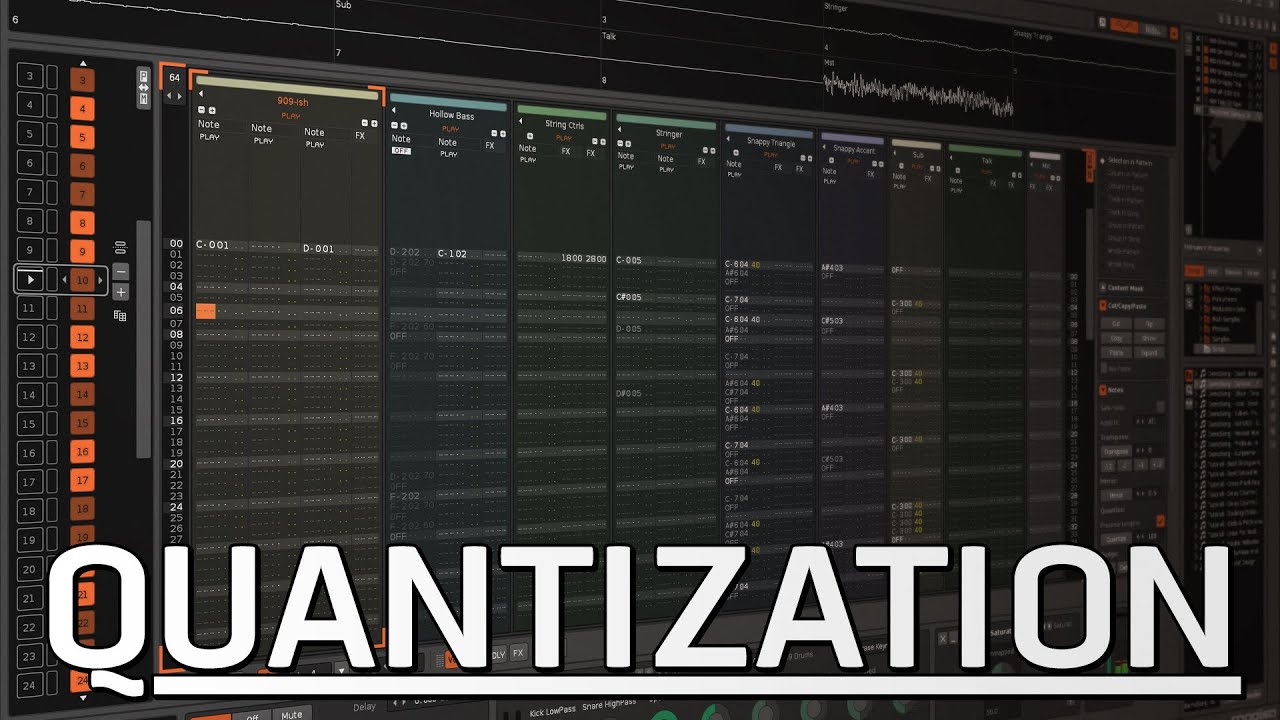
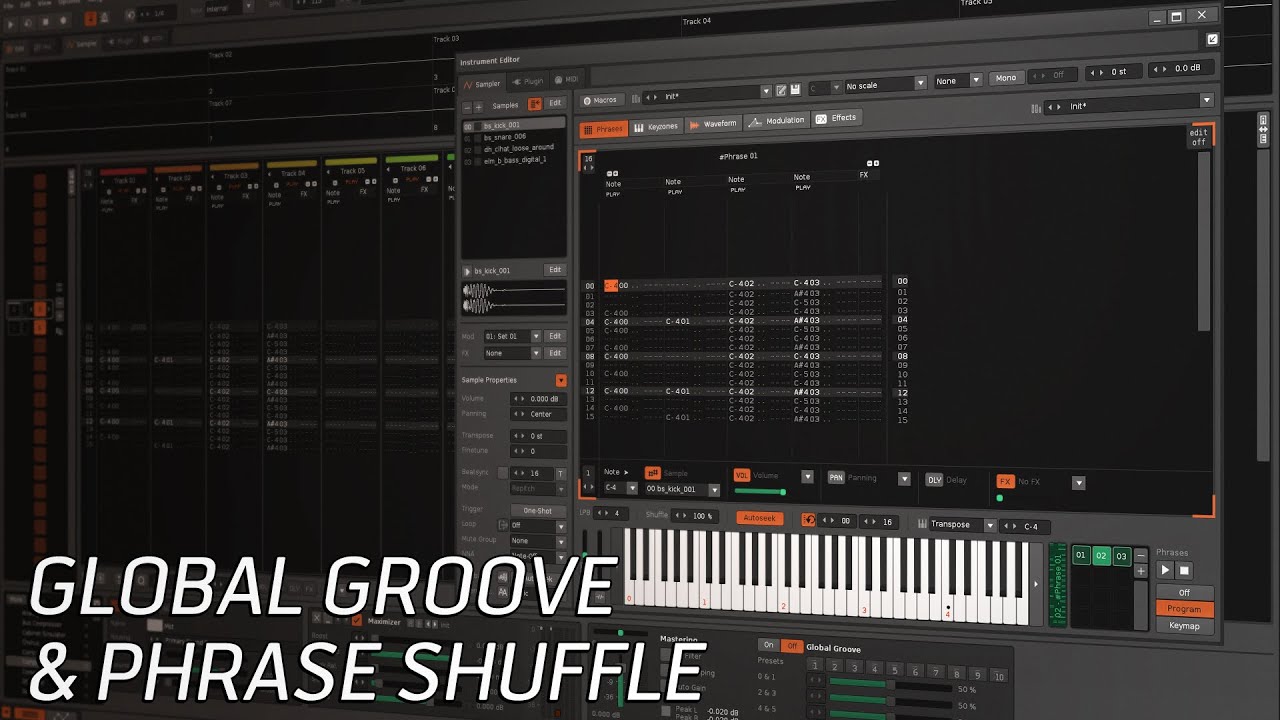
Groove extraction is very much already a thing in renoise. Slice your break, render slices to phrase, replace your samples as desired. Easy peasy. Save the phrase if you want. All the relevant slice timing info (functionally the same as q points, no?) gets saved in the rendered phrase.
Right click on a sliced sample, select slices, render slices to phrase.
Unless I’m misunderstanding this topic entirely (possible, lol), we’ve already got a functional equivalent to Q points with this method.
Hi yeah, it was the original Method in Rex Slicing in Cubase, during the 90’s where Q points add a 3rd point, ( • a Timing Point • ) which is the point at which the Slice is Timed from
So a slice starts from the Accent of the Hit, not from the Start Point… Groove ( extraction itself ) is completely Secondary, this is about timing the Accents of the Hits
( this means a slice where the accent is @ 200ms… will start playing 200ms ahead of the Quantized Note… and the Accent will land on the Note Quantize Position = Q-Point )
That’s why much of the beats made pre 2000 sound so groovy, compared to much what has been made after
There is currently no software on the planet, that implements ( anything close to ) the original Q-Point architecture
This is why i am kind of requesting it, because it sounds real good
Many DAW have that, Item: Set snap offset to [...] set of actions in reaper for example. (So you can just tab to a transient & hit a key you’ve assigned to Item: Set snap offset to cursor) I don’t se how this is considered some kind of lost technology ? Again unless I’m missing something.
But if you slice the samples normally in Renoise, the start point is where the hit is right?
I’m new to Renoise, but this has me curious. OP says that today’s software forces you to remove sound from the start of slices:
that literally force people to remove parts of the sound that actually make the vibe in the whole beat
But old-school samplers were far less sophisticated than today. If you use start offset, you get 256 levels of resolution. What did you get back when, assuming the device had auto-slicing? Wouldn’t simply using 0Sxx at 16, 32, 64, (0x10, 20, 40) etc. intervals give you a similar grid-like effect, complete with imperfect microtimings?
In my brief research, Chemical Brothers pre-2000 had to use manual beat slicing, setting start and end points individually, with the MPC 3000. The same is true for the SP1200. There’s not much more old-school than that. If there’s any timing mojo, it would have to be manual playback recording, i.e. playing in the beats, plus the Timing Correct feature that included swing templates.
So, if anything is missing, it’s a kind of quantize feature that’s set to a swing template, because you can already live record your performance into the pattern editor. But renoise has groove functions in the master track as well as quantize.
I think , if music was “more groovy than today” was a matter of personal taste of the producer. Big beat was pretty popular around 2000-ish, maybe that’s why.. They certainly played around with quantization or left it out to keep the swing. House was and is still pretty “groovy” with the 16th triplet shufflely stuff. I am pretty sure renoise can do everything and more, that Cubase 5 could. Playing samples live automatically gives it “imperfect” timing just like a live drummer is never 100% on time. But maybe I misunderstood, what OP thinks is different today in software.
Yeah kind of apologies for referring to The Chemical Brothers I do know that they used Cubase when Cubase had this feature that is still not in any other software up until this day the other band I mentioned Prodigy for sure did use this because they used Cubase VST audio which did have that feature at the time of their making of the the jilted generation album is where they recorded the audio into and also their next album too so it has real real musical value really and especially when you want to have clubs that have pre shifted 20 milliseconds here like incoming swooshes it’s really handy and it’s it’s really a time saver to have that cue point on each hit
Yeah and I agree with you is there’s many ways to make great grooves - this is just one of the things that is like micro tuning kind of like when you listen to Motown Records all of those sounds are micro tuned and you know tuned by humans to the best sounding tuning that’s possible this is similar to that you will just only feel it and know it once you use it you really feel the difference and it’s just – it really is a difference – it’s like like a light year difference — anyhow enough explaining maybe you know some people just have to hear it to know what it is just like tuning the instrument as in compared to the nowadays tuning which is out of tune compared to like the way the Motowns would for example doing their instruments or Jimi Hendrix who would always tune the guitar perfectly which is better tuned than what the automatic tuning allows which is why we all have micro tuning because it sounds just as good as Jimi Hendrix you just have to feel it to know it kind of
anyhow the truth remains it was a feature of the beat slicing because it is a great feature it was dropped by propellerhead and Steinberg and now nobody has that anywhere and I would like that to be a feature because it is a basic feature of beat slicing that was already really so important in the beginning anyhow I understand you have to kind of understand to understand or something
@SoundLight unfortunately, it seems like / feels like, the current Renoise framework doesn’t allow for scripting something like this in, since we can’t “re-mold” the sample content so that it would be played differently than how it already is played.
would be nice if it was possible, of course, but so far i can’t quite fathom how it could be done, wihtout getting real deep into, say, the modulation matrix for a sample, and i worry it wouldn’t be close enough for comfort, i.e. could be a disappointment, in effect, even after a lot of time has been spent trying to make it happen / work a specific way.
Hey it’s OK I understand this is something that requires like implementation on the software level
thank you for everybody and everyone for your help – and excuse me for the lack of formatting was just trying to get the idea across them speak music through words which is not something that’s maybe the best idea
I still didn’t get the difference to what we use now, so I asked our new robotic overlords for clarification:
In Cubase 5, Q-Points are a feature related to the VST automation system, specifically for automation curves and breakpoints within the project.
What are Q-Points?
Q-Points (short for “Quantize Points”) are special breakpoints in automation lanes that allow you to quantize or snap automation data to a grid, similar to how you quantize MIDI notes.
They are used to adjust the timing and value of automation points, making it easier to create precise, rhythmic, or synchronized automation movements.
How Q-Points Work in Cubase 5 VST Automation:
When you draw or record automation, you create breakpoints (nodes) on the automation curve.
Q-Points let you snap these breakpoints to a musical grid (e.g., 1/4 notes, 1/8 notes, etc.), ensuring your automation changes align with the project tempo.
This is especially useful for volume swells, filter sweeps, or panning effects that need to sync with the music.
*Summary:
The specific “Q-Points” name is no longer used, but the ability to quantize or snap automation points to a grid is still available in modern Cubase versions, just under different terminology and with updated workflows.