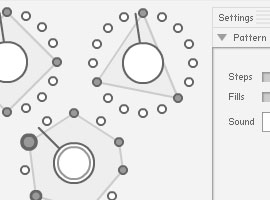
XronoMorph is a free OS X and Windows app for creating multilayered rhythmic and melodic loops (hockets). Each rhythmic layer is visualized as a polygon inscribed in a circle, and each polygon can be constructed according to two different mathematical principles: perfect balance and well-formedness (aka MOS). These principles generalize polyrhythms, additive, and Euclidean rhythms. Furthermore, rhythms can be smoothly morphed between, and irrational rhythms with no regular pulse can also be easily constructed. XronoMorph subsumes the earlier MeanTimes app described in Milne, A. J. and Dean, R. T. (2016). Each polygon can play an independent sound, and XronoMorph comes with a useful selection of samples to play the rhythms. Alternatively, you can load your own VST or AU plugins, or send MIDI to an external software or hardware synth. The rhythmic loops can be saved as presets within XronoMorph; they can also be saved as Scala scale tuning files, which means XronoMorph can be used as a tool for designing well-formed (MOS) and perfectly balanced microtonal scales.
Perfectly balanced and well-formed rhythms
The mathematical principles utilized by XronoMorph are perfect balance and well-formedness (MOS). Perfect balance is a generalization of the polyrhythms found in many African and jazz musical traditions. A rhythm is perfectly balanced when the mean position (centre of gravity) of all its rhythmic events, when arranged on a circle, is the centre of that circle. Well-formedness is a generalization of the additive rhythms found in aksak (Balkan), sub-Saharan African, and progressive rock musical traditions. Well-formed rhythms contain no more than two interonset intervals, arranged as evenly as possible. WF rhythm are typically nested by faster WF rhythms, which in combination form complex interlocking rhythmic hierarchies.
The rhythmic loops can be saved as presets within XronoMorph; they can also be saved as Scala scale tuning files, which means XronoMorph can be used as a tool for designing well-formed (MOS) and perfectly balanced microtonal scales.
Hey, that’s interesting. I always did imagine microtonality as being something which could somehow be inscribed in a circle…
Ive been trying to do this for the past 3 hours yet no luck as somehow even though I set Xronomorph to the same midi port via LoopMIDI or MIDI OX / Loop Be 1 I am receiving no midi data in reaper. Hopefully someone here might know why ?
I also would like to ask a clarifying question. Why is there no sound in xronomorph ? Besides using the presets I have no internal sound output on my pc when I starting creating rhytms on my own. Anyone know why that is ?
I have just started using. And so not everything is quite clear enough.
not an answer to your question, but wanted to chime in to say that renoise has robust native solutions for modal/additive and euclidian rhythm generation via the new “pattrns” pattern scripting engine within instrument (and VSTi) phrases. Worth looking into if that’s the end result you are after. Quite a bit can be done along these lines with the legacy phrase engine as well, but I would suggest starting with the pattrns examples. It’s pretty fun and can easily make for some awesome modal/additive and euclidian goodness once you scale the learning curve a little bit